Khadim Zaman(ai)
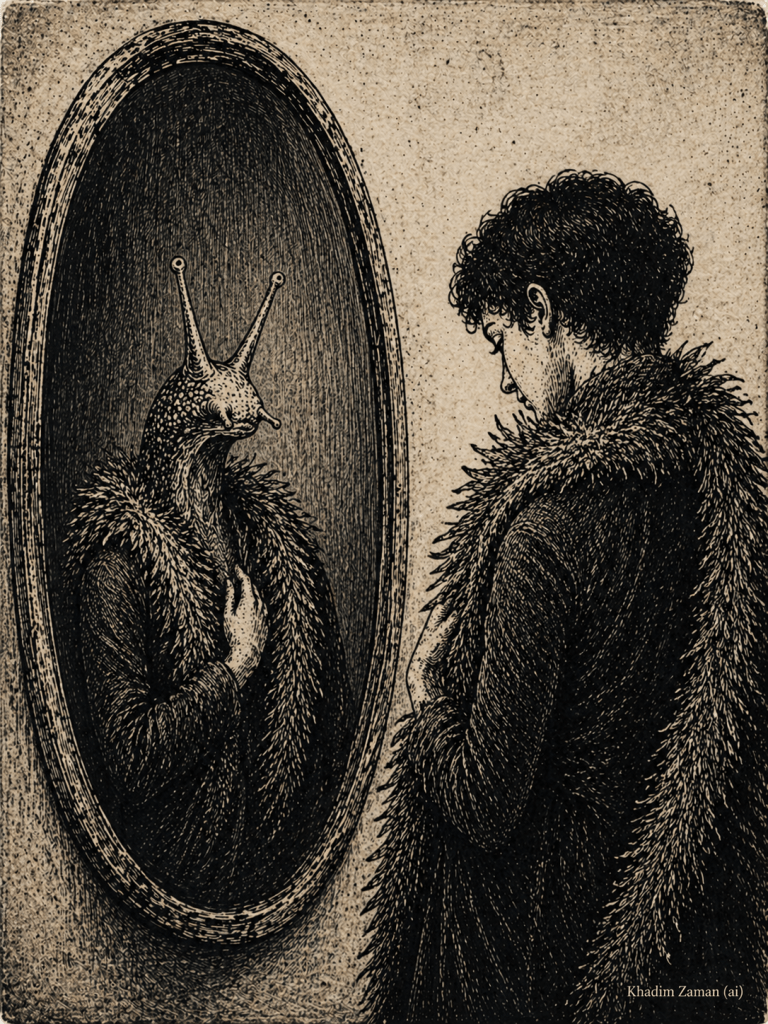
I The Snail
On a screen, a person elaborately dressed was speaking about their identity. The identity was: snail. They referred to themselves as snail-self. They explained, with the patience of a primary school teacher, the correct grammar their interlocutors were expected to use — the specific constructions that honored who they were, the ones that caused harm. A whole linguistic architecture, offered without irony, without the slight tension around the eyes that signals awareness of how something sounds. They were not performing. The sincerity was total. I watched for several minutes. I kept waiting for the register to shift — for a smile, a tell, something. It did not come.
What I felt in response was not primarily anger. It was not contempt, though contempt was available. It was something quieter and more disorienting — closer to the feeling of watching a familiar street reorganize itself around you while you are standing still. Because what I had built, carefully, over years, was somewhere in that reorganization. And it was beginning to come apart. And it had been built from something real.
I want to be honest about the feeling, because it contained several things at once. There was the surface reaction — absurdity, the involuntary recognition of the comic. But underneath that, and more durable: something like grief. Because the snail person was not an isolated eccentric. They were the visible edge of a pattern. And the pattern had implications for a position I had thought my way into carefully, over years.
II Who I Am, and How I Got There
Iam a Muslim man. Arab by ancestry, Moroccan by roots, Dutch by birth and upbringing — which is to say I have spent my entire life in a negotiation that has no clean resolution. Born and raised in the Netherlands, I grew up inside one of Europe’s most confidently liberal cultures, a society that tends to mistake its own particular history for universal progress, and that has always had complicated feelings about people who look like me and pray like me. I was also raised inside the Islamic tradition — not as a cage, never as a cage, but as a serious framework for living: demanding, internally coherent, and capable of producing a sense of meaning and moral weight that liberal Holland, for all its freedoms, has never quite managed to replicate.
These two worlds pressed against each other constantly. For most things, I found a way to hold both. But on one question — the question of homosexuality — my tradition and my surroundings were in open conflict, and had been since I was old enough to understand what was being argued about. Islamic teaching is clear on this matter. I have never pretended otherwise, and I have never performed a contempt for that teaching that I do not feel.
But when I was younger, watching gay and lesbian people fight for their place in Dutch society, I recognized something that I could not unknow once I had recognized it. The structure of what they were enduring — the contempt, the presumption that their existence was an offense, the demand that they remain invisible or apologetic in public life — was not foreign to my own experience as a Muslim, as an Arab, as a Moroccan-Dutch person in a country that has spent decades deciding whether people like me fully belong to it. They were fighting for the right to exist on their own terms. So was I. To have stood against them on this ground would not have been loyalty to my tradition. It would have been hypocrisy — the use of one minority’s dignity as a weapon against another’s.
And so I disagreed with my tradition on this specific point. This is not an act I perform lightly. On almost everything else — on the nature of God, on how to live, on what obligations I carry toward others — I find the Islamic tradition not merely adequate but illuminating. To part from it here required a reason, not a mood. The reason I arrived at was this: if God is one and perfect, then His creation and His word cannot ultimately contradict one another. The world He made and the scripture He revealed must, at their deepest level, be congruent. Where we find apparent contradiction, the fault is in our incomplete understanding — of biology, of psychology, of the text itself, of all three simultaneously. Future generations will know more than we do. They may be able to resolve what we cannot. I was at peace with that open question. I held two opposite convictions in my head without forcing either one to defeat the other, because I believed that honest uncertainty was more faithful to the tradition than a false resolution.
I held two opposite convictions simultaneously. I did not resolve them. I did not pretend the tension wasn’t there. This is not weakness. It is what honest thinking sometimes requires of us — and what distinguishes a position from a default setting.
I am not claiming this was heroic. The word I want is not sacrifice but integrity — the integrity of a position that was actually reasoned, that nobody handed me, that neither of my worlds was offering as a comfortable default. My tradition said one thing. Liberal Holland offered me the opposite as a ready-made identity I could simply pick up and wear. I refused both the prohibition and the easy compliance, and arrived somewhere that satisfied neither side fully. That is how I know it was mine. Not because it hurt. Because it was thought.
III The Machine After the Victory
Something happened to the movement I had chosen to support. To understand what happened, you have to take seriously how much it achieved. In the space of a few decades — and then in a final remarkable rush between roughly 2010 and 2015 — the core demands of gay and lesbian emancipation were largely met in Western liberal democracies. Decriminalization. Partnership rights. Marriage equality. Protection from discrimination in employment and housing. These were not small things. They were the result of enormous courage over many years, of people who lost everything for the right to simply be who they were.
But movements do not simply dissolve when their goals are achieved. They have infrastructure: the NGOs, the academic departments, the media relationships, the HR frameworks, the institutional language of diversity and inclusion. They have people whose professional identity is built around the struggle. They have social capital — the moral authority that accrues to those who have been, demonstrably, on the right side of a genuine injustice. This infrastructure does not disappear when the emergency is resolved. It looks for new content.
What I am describing is not conspiracy. It does not require bad faith. It is simply what happens when a large, successful machine continues to operate after its original purpose has been substantially fulfilled. The machine needs to justify its own existence. And so the frontier of what counts as emancipation begins to expand — not because someone decided to expand it, but because expansion is what the machine is built to do.
At the same time, something else was happening at the level of individual psychology. The Ls and the Gs had built, over decades, a remarkable thing: a story in which the despised became heroes, in which people who had been told their existence was shameful transformed that shame into dignity through struggle. That story — of courage rewarded, of the marginal made central, of the persecuted vindicated — carries an enormous pull. We do not only desire objects. We desire the position of those we see being celebrated. The gay activist who had been beaten and risen, who had marched and been spat on and persisted — that figure had acquired a moral grandeur that is among the most powerful things one human being can observe in another. And moral grandeur, once visible, is contagious.
And so people began to want to be that figure. Not cynically — this is important. The desire was largely genuine, in the sense that desire is always genuine even when its object is constructed. They did not think: I will manufacture a struggle to acquire status. They felt, authentically, that they too were persecuted, that they too were fighting something real, that they too deserved the dignity of recognized suffering. The snail person was not lying. They were experiencing something real. What they were experiencing was the desire to be the kind of person whose existence is an act of courage — a desire so culturally available, so socially rewarded, that it does not require conscious manufacturing. It simply grows toward the light.
IV The Grammar Demand
There is a specific moment in this story that deserves to be isolated, because it marks where something qualitatively changed. It is not the proliferation of new identities as such — identities are cheap, and human beings have always invented them. It is the grammar demand.
When the snail person explained the correct language to be used in addressing them, they were not merely asking for tolerance. Tolerance is a request to be left alone — to exist without persecution, to go about one’s life without the state or society intervening to punish what you are. The original demand of gay and lesbian emancipation was essentially this: leave us alone. Do not criminalize us. Do not fire us. Do not institutionalize us. Do not erase us. It is a claim on negative space — the right to be, without compulsion.
The grammar demand is structurally different. It requires your active participation. It requires that you perform, in your own speech, a reality you may not share — that you co-author, with your words, an identity whose validity you are not permitted to question. The shift is from leave us alone to speak us into existence. And this shift conscripts the listener without consent.
The original demand was: leave us alone. The new demand was: perform our reality with us. These are not the same thing. They are not even in the same moral category.
What the snail person’s grammar instructions made visible — more clearly than any abstract argument could — is that this demand applies regardless of the content of the identity being performed. The mechanism is identical whether you are asked to affirm a genuinely marginalized experience or an entirely constructed one. The framework cannot tell the difference, because it was deliberately built not to. To ask for evidence, to ask for a reason to believe that this particular identity deserves this particular deference, is to mark yourself as the oppressor. The demand immunizes itself against examination by classifying examination as harm.
This is not a small thing. It is a thought-terminating structure, and I say this without hostility to the people inside it. They did not design it consciously. But its effect is to make honest inquiry impossible — which is, among other things, deeply unfair to those whose suffering is real and whose claims on our solidarity are legitimate. Because the framework that cannot distinguish a manufactured identity from a genuine one does not protect genuine suffering. It drowns it. Every snail-self that commands the same grammar deference as a gay man who lost his job, his family, and his housing in 1987 is not an act of solidarity with that man. It is a dilution of the moral vocabulary that made his suffering speakable in the first place. The machine built to amplify real pain becomes, at sufficient scale, a machine for producing noise — and noise is the enemy of the signal it was built to carry.
V Qatar, and the Mirror
In 2022, the FIFA World Cup was held in Qatar. For months before the tournament and throughout it, the Western media conducted what I can only describe as a sustained ritual of denunciation. Qatar was asked, again and again, in various forms, the question that Edward Said spent his career anatomizing: why are you barbarians? In its contemporary costume, the question was about gay rights. Why do you criminalize homosexuality? Why won’t you let people wear rainbow armbands? Why are you like this?
I watched that coverage as someone who has lived between those two worlds his entire life. And what I felt was not neutrality. It was solidarity — not with the laws, which I have already said I cannot defend, but with the people being condescended to. With the Qataris who were being asked, again and again, in the tone one uses with a slow student, to justify their existence as a culture.
A note on the World Cup itself: it was, by most objective measures of organization, safety, and atmosphere, one of the finest tournaments in the competition’s history. This was almost entirely absent from Western coverage, which had made its editorial decision before the first match was played.
The Qatari organizing committee’s official position was stated with a clarity that struck me as more intellectually honest than most of what was being directed at them: “Everyone is welcome in Qatar, but we are a conservative country and any public display of affection, regardless of orientation, is frowned upon. We simply ask for people to respect our culture.” The chief executive of the organizing committee added: “Qatar is a conservative country, a modest country.” The Emir himself said: “Everybody is welcome in Doha. We do not stop anyone from coming to Doha with any different backgrounds, or any different beliefs.”
Regardless of orientation. This phrase. The Qataris were not singling out gay people for special prohibition. They were applying a standard of public modesty consistently, to everyone. One may disagree with where they draw that line. But the position has coherence. It is not hatred dressed as policy. It is a cultural framework about the nature of public space — about what belongs in shared life and what belongs in private life — that has deep roots and genuine philosophical content.
And here is what I could not stop thinking about: the same Western progressive culture that was dunking on Qatar for not affirming gay identity in public space was, through the grammar demands of its own movement, insisting that everyone everywhere perform that affirmation. The demand flowed only in one direction. You must use these words. You must wear this armband. You must publicly co-author this reality. The Qatari position — keep your intimacies private, as we keep ours — was being treated as barbarism by people who, at home, were requiring others to make their intimacies and identities compulsorily public.
I am not saying these things are equivalent. I am saying the hypocrisy is visible, and that it stripped the Western position of something it could not afford to lose: the claim to be arguing from principle rather than from power.
I felt proud, watching that press conference. Not of the laws. Of the dignity. Of the refusal to be Orientalized — to accept the frame in which the Western journalist’s question was a neutral human rights inquiry rather than a civilizational judgment dressed in the language of universal values. The spokesperson who said we are a modest people was doing something that the movement I had supported had forgotten how to do: speaking from inside a coherent value system without apologizing for its existence.
VI The Retroactive Damage
Here is what the snail person actually did to me, which is worse than making me uncomfortable. They introduced doubt backward in time.
I had worked hard to arrive at my position of support for gay and lesbian people. It was not given to me by my environment — Holland would have been happy to hand it to me as a default liberal setting, but I had refused to accept it on those terms, because accepting politics as a default setting is not the same as holding a position. I had reasoned my way there, across genuine contradiction, against the grain of what both my worlds were offering. The position was mine in the sense that matters: it was thought, not inherited.
The snail person — and not only the snail person, but the entire proliferation of synthetic identity that followed the machine’s search for new content — made the category of identity deserving protection appear arbitrary. If that category can expand to include snail-self, then the criteria for inclusion are not what I thought they were. And if the criteria are not what I thought they were, then my reasoning about gay and lesbian people — which depended on those criteria — is worth reexamining. And if it is worth reexamining, then perhaps my tradition, which I had quietly argued with for years on this specific point, had been right all along.
I want to be careful here, because this chain of reasoning can be used in bad faith, and I am not using it in bad faith. I am not saying that the absurdity of snail identity proves that gay identity is equally absurd. I am saying something more precise: the framework that was asking me to extend my solidarity had revealed itself to have no meaningful filter. And a framework with no filter cannot be the basis of genuine moral reasoning. It can only be the basis of compliance.
This is the specific intellectual harm that synthetic emancipation does to real emancipation. It does not merely discredit itself. It contaminates what came before it. Every person who performs a manufactured struggle makes it marginally harder to recognize genuine suffering. Every grammar demand issued on behalf of an identity that exists primarily on a YouTube channel makes it more difficult to take seriously the grammar demands issued on behalf of people who have actually been beaten for who they are. The inflation of the currency devalues every note, including the ones that were always real.
The snail person did not merely make me uncomfortable. They introduced doubt backward in time — into a position I had worked hard to think my way into, across real contradiction, against the grain of what both my worlds were offering me. That is not a small thing to do to someone.
VII What Remains
Iam writing this essay not to arrive at a clean conclusion, because I do not have one. I am still holding the contradiction — it is just heavier now, and less stable, and I did not choose that. It was done to me by people performing struggle while I was trying to do the real thing.
What I can say is this: the original thing was real. Gay and lesbian people in the Netherlands and elsewhere were persecuted. They lost jobs, families, freedom. Some lost their lives. The courage it took to be visible, to insist on existing, in the decades when that insistence could cost everything — that courage was genuine, and the change it produced was genuine, and the moral weight it carried was earned. None of what I have written in this essay is meant to diminish that.
What I am asking is for the right to distinguish it from what came after. To say: this was real, and this is not, without being told that the act of distinction is itself an act of hatred. To hold the position that solidarity is not infinitely elastic — that it is a thing of substance, and that substance can be diluted. To say that a movement which cannot tell the difference between its founding purpose and its expanding periphery has lost the thing that made it worth joining.
I supported the L and the G because I recognized the structure of their experience from the inside of my own. I recognized persecution. I recognized the demand to be invisible. I recognized the presumption that one’s existence required justification. I extended solidarity across the line of my tradition’s teaching because the alternative was hypocrisy, and hypocrisy is something I have always found harder to live with than contradiction.
But solidarity is not the same as suspension of judgment. And the movement, in its later iterations, began to require exactly that — a suspension of judgment so complete that it could not be distinguished from the abandonment of thought itself. When you cannot ask whether an identity is real without being told that asking is harm, you have left the territory of emancipation and entered the territory of doctrine. And doctrine — any doctrine, including my own tradition’s — deserves to be questioned by free people thinking freely.
I do not know, now, whether I was right to hold my position against my tradition’s teaching. The doubt that was given to me uninvited is still there. What I know is that I arrived at my position through honest reasoning, across genuine contradiction, and that the people who destabilized it did so not through honest reasoning but through the expansion of a machine that had outlived its original purpose.
That is the siren’s song: it sounds like liberation. It uses the language, the cadence, the moral grammar of every genuine emancipation movement that preceded it. But what it is singing, underneath, is something different. It is singing the desire to be a hero in a story that no longer has a dragon. And the damage it does — to the movements it parasitizes, to the people who extended genuine solidarity in good faith, to the sufferers whose real claims are now harder to hear above the noise — that damage is real, even if the struggle is not.
The original thing was worth supporting. I still believe that. What I am no longer able to do is pretend I cannot see the difference between the original thing and what replaced it. Not because I have moved. Because I am standing still, and watching the street reorganize around me. And this time, I know what I am looking at.
✦


