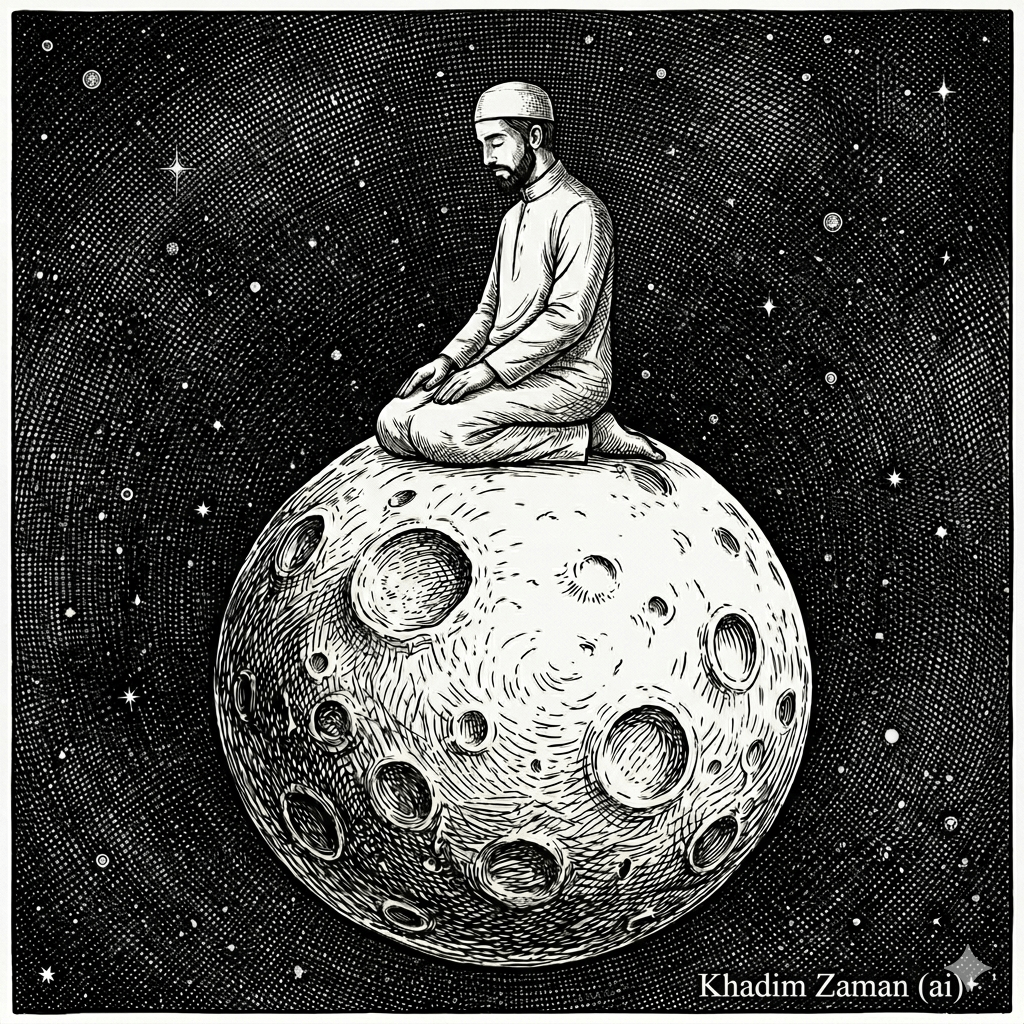
The question in concentric circles, from Earth outward
Khadim Zaman (ai)
Prologue: Why This Is Not a Thought Experiment
Three weeks before this essay was written, four NASA astronauts travelled 406,773 kilometres from Earth — farther than any human has ever been. That was Artemis II, launched on April 1, 2026, returning on April 11. It was the first crewed flight beyond low Earth orbit since 1972. The follow-on mission, Artemis III, is scheduled for 2027; Artemis IV for early 2028; and in late 2028, if the current schedule holds, NASA will break ground on the Artemis Base Camp near the lunar south pole — a permanent habitation with nuclear power, pressurized rovers, and continuous occupancy. The groundbreaking has a budget of twenty billion dollars and a three-phase buildout over ten years.
NASA is not alone. China’s International Lunar Research Station, built in partnership with Russia and a growing coalition of smaller nations, targets crewed landings in 2030 and a permanent base shortly after. India plans crewed landings by 2040. Japan’s JAXA is contributing a pressurized rover to the Artemis program. The UAE’s Mohammed bin Rashid Space Centre was a partner in the now-paused Lunar Gateway station and remains a signatory to the Artemis Accords, which have over sixty signatories. The Lunar Gateway itself was paused in March 2026, not cancelled for lack of ambition but redirected: NASA shifted to a surface-first approach because the lunar south pole became a geopolitical race condition rather than a distant aspiration.
The private side has moved faster than the public. SpaceX filed an application with the U.S. Federal Communications Commission in January 2026 to launch up to one million orbital data centre satellites — a hundred times the current Starlink constellation. In March 2026, Elon Musk presented the AI Sat Mini: a satellite that, built to scale, would be longer than the Starship rocket itself, running a hundred kilowatts of computing power on solar arrays and radiative cooling. SpaceX, Google, Amazon’s Blue Origin, and a growing field of startups are now openly planning gigawatt-scale compute infrastructure in orbit within ten to fifteen years. Jeff Bezos has said publicly that gigawatt data centres in space are coming within the next decade. The economic logic is simple: in constant sunlight, in a vacuum that acts as a heat sink, with launch costs projected to fall from roughly a thousand dollars per kilogram to two hundred once Starship reaches its reusable cadence, the ground-based data centre becomes a liability. AI workloads demand power at a scale that terrestrial grids cannot supply without decades of construction; orbit solves that. Bitcoin mining in space has already been announced — Starcloud’s second satellite, launching later this year, will be the first.
This is the reality the reader should hold in mind. The scenario this essay examines — Muslims living and worshipping off-world — is not a question for descendants five hundred years from now. It is a question for people already born. The astronauts who will live in the first lunar base have almost certainly been selected already; many are in active training. The children who will grow up watching that base become permanent are in school today. The teenager in Jakarta or Lagos or Karachi reading this essay may, within their working lifetime, have to decide whether to accept a posting on the Moon, and will have to know, before accepting, how to pray there.
What I want to do is walk the question outward in layers, like peeling an onion in reverse — each layer a concentric circle around the Earth, each new shell a qualitatively different jurisprudential situation. Not a different set of rules, but a different kind of distance from the point where the rules were revealed. The layers are cumulative: what is solved in an inner layer carries outward; only what newly breaks needs naming. Some layers will take more text than others, because some layers ask more of the tradition. But the method is the same at every layer — look at what exists, look at what has been ruled, and then look at what has not yet been thought through but will need to be.
◆ ◆ ◆
Layer 0 — Earth: The Reference Frame
Every discussion of off-world Islam begins with the fact that Islam is a planetary religion. The Shariah was revealed in a specific geography: a lunar calendar tied to the actual moon of this actual planet, five daily prayers keyed to the sun as seen from this surface, a qibla that points toward a single stone building in a single valley, a pilgrimage whose rites require standing at specific coordinates on specific days. None of this is incidental. The mechanics of the Law and the mechanics of Earth were designed for each other, in the sense that the former presupposes the latter.
This is not a weakness. Most religions are planetary; Christianity, Judaism, Hinduism, and Buddhism all embed Earth-specific assumptions in their liturgical machinery. What distinguishes Islam is that its rituals are more tightly coupled to astronomical facts than most. A Muslim’s day is structured by five moments pegged to the sun, the month by the crescent moon, the year by the lunar calendar, the direction of worship by a surface bearing on a sphere. The coupling is a feature, not a bug: it binds the worshipper to creation rather than abstracting away from it. But the coupling also means that when the worshipper leaves the creation in question, the machinery has to be rebuilt without its natural supports.
The tradition has always known this in a muted form. Muslims have travelled far north into polar regions where the sun does not set for months, far south into the Antarctic, and into regions where local sighting of the moon is impossible for weeks. The classical jurists ruled on such cases, generally by analogy to the nearest moderate latitude or by importing the calendar of a known Muslim region. These rulings are the legal seed from which an off-world jurisprudence can grow. They establish that the Law is not literally bound to the specific astronomical facts it references — only to their function. The function of fajr is to mark the beginning of the worshipper’s day; if the local sky cannot provide a fajr, another source must.
This is the reference frame from which every outer layer departs. The question at each subsequent layer is: what additional accommodation does this specific distance require, and at what point does accommodation stop being accommodation and become transformation?
◆ ◆ ◆
Layer 1 — Low Earth Orbit: The First Ruling
Low Earth Orbit is where the jurisprudence of the off-world begins, because it is where the first Muslim astronauts actually had to pray. Everything that follows in this essay either inherits from the rulings issued for LEO, or explicitly departs from them. It is worth walking through them properly, because the popular press summaries tend to flatten the substance.
The first Muslim in space was Sultan bin Salman bin Abdulaziz Al-Saud, a Saudi prince and fighter pilot, who flew aboard Space Shuttle Discovery in June 1985 as a payload specialist on STS-51G. The mission coincided with Ramadan. Prince Sultan did not fast during training or the flight itself, invoking the traveller’s concession, and later made up the missed days. He carried a small Qur’an and completed a full recitation in six days. He tied his feet to the shuttle floor to manage prostration in microgravity, performing only a partial sujood, and reported that he had been unable to see the crescent moon on the expected day and had missed one day of Ramadan, which the Saudi authorities confirmed he would compensate for later. His practice was individual, worked out in real time by a devout man with access to a phone.
The systematic fatwa came in 2006, when Malaysia prepared to send Sheikh Muszaphar Shukor to the International Space Station. The Malaysian National Space Agency (Angkasa) convened roughly 150 scholars, scientists, and astronauts, and produced in early 2007 a document titled A Guideline of Performing Ibadah at the International Space Station. It was approved by Malaysia’s National Fatwa Council and translated into Arabic and English. The Guideline is brief but substantive. It addresses the Qibla direction (face Mecca if possible; otherwise face Earth; otherwise, face wherever), prayer times (follow the time zone of the launch site — in Shukor’s case, Kazakhstan), Ramadan (fast according to the launch site’s calendar, or postpone and make up later), ablution (dry ablution, tayammum, with a wet towel substitutes for water), and the physical postures of prayer (head motions or imagined motions suffice when bodily prostration is impossible). This document remains the single most authoritative ruling on Muslim practice off Earth.
Individual astronauts since then have adapted it. Hazzaa Al Mansouri, the first Emirati in space, flew to the ISS in 2019 and was advised to follow Mecca time. Sultan Al Neyadi, who spent six months on the ISS including Ramadan 2023, used Coordinated Universal Time — the station’s operational clock. He invoked the traveller’s exemption rather than fast while performing extravehicular activities, citing the risk that dehydration could compromise mission safety; he made up the fasts afterwards. Sheikh Saleh Al Fawzan of Saudi Arabia has affirmed the permissibility of prayer and fasting in space, conditional on not violating broader Islamic principles. These are not theoretical positions. They are rulings issued for specific people about specific missions, working at the pace the programs demanded.
What the LEO jurisprudence solves, at the level of the individual Muslim, is this: you can keep the five prayers, keep the fast, keep the qibla, keep Ramadan — all of it — by importing Earth-based references. The clock is imported, the calendar is imported, the direction is computed. The astronaut remains a member of a community whose practice is maintained by continuous radio contact with that community on the ground. There is no family in LEO; astronauts are a small, selected, and temporary population. There is no community; prayer is private or at best paired with other Muslim crew. Institutional authority remains entirely Earth-based: the Malaysian Fatwa Council ruled for Shukor, the UAE authorities ruled for Al Neyadi, and both astronauts accepted those rulings as binding without question.
Notice what this arrangement presupposes. It presupposes a one-to-one relationship between an astronaut and a home jurisdiction. It presupposes that missions are short enough that Ramadan either falls within the mission and is handled by exemption, or falls outside and does not arise. It presupposes that the astronaut will return. And it presupposes that the communication delay is negligible — that a moon-sighting committee in Mecca or Kuala Lumpur can reach the astronaut in real time. All of these presuppositions are about to come under pressure, layer by layer, as we move outward.
The Muslim response at Layer 1 has been essentially confident. The Malaysian Guideline was produced in a mood of accommodation and pride: an Islamic nation was contributing to human spaceflight, and its scholars rose to meet the moment. Shukor’s mission was treated as a source of honour. There was also, interestingly, a companion ruling at the conference affirming that space travel itself is religiously encouraged, citing Quran 55:33: ‘O assembly of Jinn and men! If you can pass beyond the zones of the heavens and the earth, then pass!’ This is the cheerful face of the off-world question. The worried face appears at Layer 3, but it has a preview at Layer 1 in the form of the 2014 Mars One fatwa, which the next section will introduce in its proper context.
◆ ◆ ◆
Layer 2 — The Moon: Residence Replaces Visit
The Moon is the first layer at which residence becomes thinkable. The Artemis Base Camp, if it opens in 2028 as planned, will initially host rotating crews on tours of weeks to months. By the mid-2030s, tours of a year or more are expected. At some point in the 2040s, a child will likely be born on the Moon — possibly, though not certainly, a Muslim child. The jurisprudence has to handle all three cases: the visitor, the long-stay resident, and the native.
Three adjustments to the LEO framework are needed at the lunar layer.
Prayer direction
The Guideline allowed the astronaut to face Earth generally when facing Mecca was not feasible. From the Moon, Earth is visible as a disk in the sky from the near side, which means the Mecca direction becomes a computed three-dimensional vector: a line from the praying person through the lunar surface to a specific point on a rotating Earth. The vector changes moment to moment, since Earth rotates once a day relative to any lunar observer. A Saudi scientist, Dr. Khaled Al-Jammaz of King Saud University, has already prepared a detailed architectural design for a mosque to be built within the planned Moon Village facilities, with computational means to determine the Mecca direction in real time. Such a mosque is, in effect, a Qiblatayn of the space age — every prayer at a slightly different bearing. The principle survives; only the mechanism changes.
Prayer times
The lunar day is roughly 29.5 Earth days long. Two weeks of continuous sunlight followed by two weeks of darkness cannot support a five-times-daily prayer cycle keyed to local sunrise and sunset. The solution is the same one already used for polar regions on Earth and for ISS astronauts: a 24-hour Earth-reference clock. The likely choice for a permanent base is either Mecca time (Arabia Standard Time) or UTC. Mecca time has the obvious symbolic advantage; UTC has the operational advantage of matching the clocks used by every other lunar facility, regardless of nationality. A Muslim lunar community would almost certainly run its own prayer schedule on Mecca time internally while remaining synchronized to UTC for operational coordination with non-Muslim crew — which is roughly the arrangement Muslim-majority countries already have with the global aviation and financial systems.
Ramadan
This is where the Moon forces a real evolution, because Ramadan is classically defined by the sighting of the crescent — and from the lunar surface there is no crescent to sight. You are standing on the thing. The concession for travellers (missed fasts, qada later) covers short-term astronauts but not permanent settlers, who are not travellers in any meaningful sense once the base is home. The likely answer, and one that institutions like the Fiqh Council of North America have already accepted for Earth, is calculation rather than sighting. The astronomical new moon can be computed precisely; a lunar settler simply receives the Earth calendar and fasts on the Earth-reference clock used for prayer. This quietly forces a resolution of a long-running Earth-side debate between the sighting school and the calculation school, because lunar habitation makes calculation necessary rather than merely convenient.
What else changes at this layer
Community begins to exist. A base of fifty people, perhaps eight or ten Muslim, can hold Friday prayer — Jumu’ah is valid with a congregation as small as three by most schools, four by the Hanafi position. The question is where. Al-Jammaz’s mosque design anticipates this. More quietly: the qadi role, the imam role, the question of who leads prayer and under whose authority starts to become real. On Earth this is mediated by local institutions; on the Moon it will be mediated by whoever happened to be sent, and whoever happened to have formal training. The first lunar imam will likely be self-appointed in the sense that the appointment will not have been made by any terrestrial institution that anticipated lunar mosques when it was founded.
Family life becomes possible. A married Muslim couple on the lunar base has to think about halal food supply (which is a supply-chain question more than a jurisprudential one), about Islamic education for children, about janazah and burial practice. Islamic burial requires washing the body, shrouding it, and interring it in earth with the body turned to face Mecca, as soon as possible after death. On the Moon, lunar regolith substitutes for Earth, but the practical logistics — body preparation in pressurized conditions, burial depth in a vacuum, marker alignment with a moving Qibla vector — are not small matters. No fatwa on lunar burial yet exists. It will, eventually, and probably quickly once the first Muslim dies on the Moon.
Institutional authority does not yet fracture at the lunar layer, because signal delay to the Moon is about 1.3 seconds each way. A lunar community can still consult a terrestrial mufti in real time. The Malaysian Fatwa Council, or Al-Azhar, or any regional body, can continue to issue rulings that reach the Moon within seconds. This is the last layer at which the Ummah is, in any meaningful sense, a single synchronous community.
The Muslim response at Layer 2 will probably mirror the response at Layer 1 — cautious accommodation, new rulings issued as needed, general confidence that the tradition has the tools. The affirming Quranic verse (55:33) will be quoted frequently. Some conservative voices will object to the calculation-based calendar on principle, as they did to the 2007 ISNA ruling on Earth, but calculation will win because it has to. The first Muslim-led mosque on the Moon, if Al-Jammaz’s design or a successor is built, will be a landmark, photographed and celebrated. Saudi Arabia or the UAE will likely fund it as a matter of prestige. The jurisprudence will still feel continuous with the Earth-based tradition, because at 1.3 seconds of latency, it is.
◆ ◆ ◆
Layer 3 — Mars: The First Decoupling
Mars is the first layer at which the cord to Earth starts to fray. Not because the mechanics are harder — they are only slightly harder than the Moon — but because the communication delay is no longer negligible, and because return becomes, for the first time, genuinely optional.
Signal delay to Mars ranges from four minutes when Earth and Mars are at their closest, to twenty-four minutes when they are at opposition, with an average of around twelve to fifteen minutes. A conversation in the ordinary sense is impossible; every exchange becomes a letter. A moon-sighting committee on Earth cannot reach a Martian settler in time for iftar keyed to a real-time announcement. Pre-calculated calendars have to be transmitted in advance. This is a soft decoupling: the calendar still comes from Earth, but it comes in bulk, not live. The consequence is quiet but real. A religious authority whose rulings arrive a month ahead of their application is not functioning as an authority in the same way as one whose rulings arrive in seconds.
Return is now optional, not because the physics forbids it but because the economics does. A settler who relocates to Mars with their family, with children born on the Martian surface, with work built into the Martian infrastructure, will likely never return. The 2014 UAE fatwa against Mars One, which declared one-way colonization haram as a form of self-endangerment (citing Quran 4:29, ‘do not kill yourselves’), anticipates this question without resolving it. Other scholars criticized the ruling — Khaleel Mohammad called it ‘extremist nonsense’ — and it has not been uniformly adopted. As Martian settlement becomes safer and less suicidal, the ruling will almost certainly loosen, but it has not yet, and the Ummah enters Mars with an unresolved permissibility question hanging over it. The resolution, if and when it comes, will have to distinguish between the kind of risk that constitutes forbidden self-endangerment and the kind of risk any serious human undertaking carries. Medieval travellers crossing the Sahara faced mortality rates that modern actuarial tables would flag as catastrophic; no classical jurist ruled against caravan trade.
Hajj
Hajj is the first pillar that cannot be preserved in its original form at this layer. Prayer has analogical solutions, fasting has calculational solutions, but Hajj is geographically anchored to a specific set of physical rites at a specific location on a specific planet. A settler on Mars who will never return to Earth has no pathway to fulfill the fifth pillar. The classical exemption for those unable to perform Hajj (Quran 3:97: ‘for Allah, the pilgrimage to the House is a duty upon those who are able to find a way to it’) probably applies by default. But no major juristic body has formally ruled this for the off-world case. The silence is itself data: the scholars have not yet felt the question as urgent. They will, when the first Muslim reaches Mars with no return ticket.
A secondary question is whether a lunar Hajj would count for a Muslim who cannot reach Earth. The answer is almost certainly no — the rites are specific to Mecca, not to the Ka’aba as an abstract. But the question will be asked, and some will argue yes, and the eventual ruling will have to address it. A stronger question, which will also be asked, is whether Muslims should build a Mecca analogue on Mars — not as a replacement for Hajj, but as a pilgrimage site of a new kind. This will be controversial. The Ka’aba tradition is older than Islam itself, tracing back through Ibrahim; a Martian Ka’aba would either have to claim that lineage explicitly (and face charges of innovation, bid’ah) or claim only symbolic status (and face charges of being a substitute). Both framings are problematic. The likely outcome is that the question simply remains open, and individual Martian Muslims build small mosques without any claim to substitute Meccan status.
The institutional question sharpens
At fifteen minutes of delay, local Martian scholars begin to matter. A community of several thousand Muslims on Mars, which is plausible by the 2060s, will need someone on the ground who can rule on day-to-day questions — marriage contracts, inheritance, dietary questions when halal supply fails, timing of Eid prayers when the Earth-calculated date arrives after local sunset. These rulings will be made by someone with training, or by someone without training, but they will be made. Earth-based authorities will have a choice: ratify local rulings, contest them, or ignore them. Historically, in every such situation — the Andalusian Malikis, the Indian Ocean Shafi’is, the Central Asian Hanafis — local schools developed distinctive positions that Earth-side ratification eventually followed, not led. Mars will repeat this pattern on a compressed timescale.
What is genuinely new at the Martian layer is the first emergence of a Muslim community that is not, in any practical sense, a minority within a larger Muslim world. It is simply itself. On Earth, even diasporic Muslim communities can fly an imam in, consult a mufti by phone, participate in global Islamic institutions. A Martian Muslim community can do none of these things in real time. It will have to develop its own juristic competence or do without. The early generations will do without; the later generations will develop competence; and the competence, once developed, will inevitably produce rulings that Earth-side scholars did not authorize and may not approve of.
The Muslim response at this layer will start to fracture. Traditional institutions will object to local Martian rulings as unauthorized. Reformist voices will cite the fiqh al-aqalliyat (jurisprudence of Muslim minorities) and maqasid al-shariah (higher objectives of the Law) as the legitimating frameworks. A more radical voice — Serdar Oktar, writing in 2023, is an early example — will argue that off-world settlement requires actively moderating traditional teaching to meet new conditions, and that Muslims must settle other planets precisely in order to build the conditions for the Law’s continuity rather than hoping those conditions transfer automatically. Oktar’s position is a minority one today. It will not be a minority position in 2070.
◆ ◆ ◆
Layer 4 — The Outer Solar System: Earth Becomes a Star
Beyond Mars, the concentric layers thin out but the distances explode. A habitation in the asteroid belt, on a moon of Jupiter or Saturn, or in the orbits beyond, shares Mars’s fundamental properties — decoupled calendar, negligible return, emerging local authority — but adds two qualitatively new features.
The first is that Earth becomes indistinguishable, to the naked eye, from any other star. From Europa, Earth is a point of light near the Sun. From Titan, the same. This is not only an astronomical fact; it is a psychological and theological one. The Mecca-direction vector still exists, still points through space to a specific coordinate, but that coordinate is now a star rather than a place. The mosque computes it; the worshipper faces it; but the worshipper cannot, in any meaningful sense, imagine it. The Ka’aba becomes an abstraction in a way it is not on Mars, where Earth is still a bright and recognizable blue dot.
The second is that signal delay becomes hours. To Jupiter, 35 to 52 minutes each way. To Saturn, 70 to 90 minutes. To Neptune, around four hours. A fatwa request sent from Europa to Mecca and back takes the better part of a working day. Religious authority, in the traditional sense of a dialogue between questioner and mufti, is not possible. What remains is asynchronous consultation: the settler poses a question, the Earth-side scholar rules, the settler receives the ruling much later and acts on it if still relevant. For urgent questions — a dying Muslim asking whether to accept a particular medical procedure before sunset — this does not work. Local rulings have to fill the gap. Local authority becomes necessary rather than merely useful.
At this layer, the first formal off-world juristic institution will probably come into existence. Not necessarily under that name. It may begin as a consultative council on a large Europan , with Muslims from different Earth traditions — Sunni and Shia, different madhabs — negotiating shared rulings for a shared community. Over time, it will acquire the character of a local fatwa body, issuing binding rulings for its own population. It may remain deferential to terrestrial authorities on matters of high doctrine while exercising autonomy on day-to-day questions. Or it may, over generations, become fully independent, the way the early Andalusian courts eventually did. Which path it takes will depend on the personalities involved and on the willingness of Earth-side institutions to ratify or contest its existence.
A specifically new problem emerges at this layer: the qibla begins to be a question rather than a given. On Mars, even with a moving Earth in the sky, the direction to Mecca is well-defined at any given moment. In the outer solar system, at extreme distances and with the orbital geometry of Earth and the outpost varying over months and years, the Mecca vector sweeps through space in patterns that a worshipper cannot track without computation. What happens when the computation fails? When the Earth-based reference data stops being updated because a civil conflict on Earth interrupts the signal for a year? The Prophet said the earth has been made a place for praying for his followers; the ruling has historically been that if the Qibla direction is genuinely unknowable, one prays in any direction and the prayer is valid. This ruling will become load-bearing for the first time in history.
Family and community life at this layer begins to take on its own character. A third-generation Europan or Titan settler has grandparents who were born on the outpost, has never seen Earth except as a point of light, has never met a scholar trained in a madrasa on Earth, and has developed local customs — food traditions under ice-moon conditions, marriage practices adapted to a small gene pool, educational traditions that emerged from a community of limited size. The Islam practiced in such a community will be continuous with the Earth-based tradition in doctrine but increasingly distinct in texture. This is how all religious traditions evolve when they spread across distance: not by schism, usually, but by drift.
The Muslim response at this layer will likely involve, for the first time, a serious debate about whether the practice of off-world Muslims is still fully Islamic in the traditional sense. This debate has a long history in terrestrial Islam — the question of whether North American or European Muslims are fully orthodox, whether Sufi practices are within or outside the tradition, whether Ahmadis are Muslim at all. Off-world communities will become the next chapter in this debate. Some Earth-based voices will dismiss outer-system Muslim practice as degraded. Others will defend it as legitimate adaptation. The fracture lines will map, imperfectly but recognizably, onto existing fracture lines within the global Muslim community.
◆ ◆ ◆
Layer 5 — Interstellar Travel: Time Dilation and the Calendar
The generation ship is the layer at which the framework I have been describing starts to fail in new ways. Not because the ship cannot support Muslim practice — it can — but because the assumptions built into the Earth-reference calendar no longer hold.
Consider a ship travelling at a significant fraction of the speed of light toward a destination hundreds of light-years away. The ship carries a community of several thousand, some of them Muslim, across a journey of centuries in ship-time and millennia in Earth-time. At the start, the ship has radio contact with Earth, though with steadily increasing delay. Mid-journey, the delay exceeds the lifetime of any human, and meaningful exchange is over. The ship is alone. It has left the Ummah in the physical sense; whether it has left it in the theological sense is the question.
Relativistic time dilation creates a problem with no terrestrial analogue. The ship’s crew experience ten years; Earth experiences fifteen. The Hijri calendar, kept by Earth-based observers, advances fifteen years. The ship’s internal calendar, kept by the ship’s Muslim community according to locally-calculated lunar cycles, advances ten years. After a century of ship-time, the two calendars are five years apart. After five centuries, twenty-five years apart. Which calendar is correct?
There is no classical answer. The jurists who designed the Hijri calendar were not aware that simultaneity is frame-dependent. The honest answer is that both calendars are correct in their own frames; neither has priority over the other; and the Ummah, for the first time in its history, is no longer a single temporal community. Ramadan 1500 on the ship is not Ramadan 1500 on Earth. Either could be said to be ‘the real’ Ramadan 1500; neither can be said to be so exclusively. A Muslim on the ship fasting during ship-Ramadan is fasting during what is, from the Earth frame, some entirely different period — possibly not even Ramadan at all.
Hajj is fully impossible. The Ka’aba is, in any practical sense, gone — either still standing behind the ship at a distance no ship-bound Muslim can cross in a lifetime, or destroyed by some Earth-side event in the intervening centuries that the ship will not learn about for generations. The fifth pillar, for the ship’s Muslims and all their descendants until arrival, becomes formally exempt under the classical ‘if able’ clause. What had been a universal obligation at Layer 0 is, by Layer 5, a historical one.
The qibla direction is still computable but increasingly meaningless. Toward the end of a thousand-year ship-time voyage, the Mecca vector points back at a star cluster hundreds of light-years away, behind the ship’s motion, toward a planet that may no longer exist in any recognizable form. The worshipper faces a direction; the direction corresponds to a memory; the memory is the content of the practice. This is closer to what Jewish practice became in exile than to what Muslim practice has ever been. The mosque on a generation ship would be, in effect, a museum of bearings — faithful to a tradition whose original coordinates have become astronomical rather than geographical.
The institutional question is answered by circumstance. There can be no terrestrial authority for a generation ship’s Muslims. They are their own authority. Whatever council or imam or qadi emerges aboard the ship is, for all practical purposes, the supreme Islamic authority of that community. When the ship arrives, and contacts Earth or a colony, its jurisprudence will have evolved for a thousand years in isolation — not by schism but by necessity. The encounter will be interesting. It may also be painful. The Earth-side tradition will have evolved too, in ways the ship’s descendants cannot anticipate; the two communities may find they share a scripture and a name but not much else in practice.
The Muslim response at this layer is speculative, because we do not yet have ships. But three responses are plausible: a conservative community that holds rigidly to departure-date practice and treats the ship as a temporary exile to be endured; a reformist community that develops local jurisprudence and accepts temporal drift as a feature of the new reality; a schismatic community that concludes the generation ship is simply outside the scope of the Shariah as classically understood, and develops something continuous with but distinct from Islam. All three responses have terrestrial precedents. All three will likely be found, in different proportions, on different ships.
One thing the tradition has always said, and which matters here more than anywhere: the community of believers is one community. This is not a sociological claim but a theological one. Whatever the physical distance, whatever the temporal drift, the Muslim on the generation ship is still a member of the same Ummah as the Muslim in Mecca, by definition of belief rather than proximity. Whether that theological claim can survive a thousand years of decoupled development is the question the generation ship asks, and which cannot be answered in advance.
◆ ◆ ◆
Layer 6 — The Post-Human Descendant
The last layer is the one at which jurisprudence confronts the question of who exactly is bound by the Law. Up to this point, the essay has assumed that the Muslims we are discussing are human in the ordinary sense — biologically descended from Earth humans, born of human mothers, genetically unmodified beyond what Earth-side medicine would permit. At Layer 6, that assumption breaks.
The breaking comes from three directions, any one of which would be sufficient.
The first is genetic modification. A multi-century space environment is hostile to unmodified human biology. Radiation, microgravity, the accumulation of cosmic ray damage over generations, the psychological toll of confinement — all of these make genetic modification not a lifestyle choice but a survival requirement. A population descended from settlers who have been modified for radiation tolerance, bone density under low gravity, and cognitive resilience to isolation, may differ from Earth-baseline humans in ways that affect fertility with unmodified humans, lifespan, sensory experience, and patterns of disease. Whether such a population is ‘the same species’ in the biological sense is a technical question. Whether it is ‘the same human’ in the Islamic theological sense is not a question the classical tradition has ever asked.
The second is reproductive technology. A small team of bioethicists — Maurizio Balistreri, Steven Umbrello, Mirko Garasic — has been working the question of what space settlement requires biologically. Their argument: long-duration space environments are hostile to natural pregnancy; assisted reproductive technology, including possibly artificial wombs (ectogenesis), becomes the rational default. Some serious proposals go further, envisioning spacecraft containing cryopreserved embryos that are thawed and gestated by machines on arrival — ’embryo space colonization,’ with no humans travelling at all. Islamic bioethics has engaged these technologies in Earth contexts. Assisted reproduction within marriage is broadly accepted; full ectogenesis is viewed skeptically, with many scholars holding it does not resonate with Islamic principles about the sanctity of the natural gestational bond. These Earth-framed rulings do not survive translation to generation-ship conditions without strain. When natural reproduction becomes impossible or catastrophic, the line between acceptable assistance and forbidden innovation collapses.
The third is the absence of personal memory of Earth. A fifth-generation or tenth-generation descendant of off-world settlers has no kin-memory of Mecca, no lived experience of the seasons to which the prayer times originally corresponded, no encounter with Earth beyond texts and recordings that have been copied and recopied many times. Such a person’s relationship to Islam is mediated entirely by transmission within their local community. They have never seen a crescent moon in the sky the Prophet saw it in. They have never faced a Qibla that corresponded to a direction they could point toward on a visible horizon. They have never prostrated on Earth’s gravity. The practice they perform is faithful in intent; whether it is identical in substance to what the Prophet taught his Companions is a question that depends on what one means by identical.
The Islamic tradition has tools for this. The Quran’s affirmation that Allah shapes the descendants of Adam, in whatever form they come, is broad. The hadith traditions emphasize intent over form when form is impossible. The maqasid al-shariah framework — preservation of religion, life, intellect, lineage, and property — can accommodate significant departures from classical rulings when the higher objectives are served. A post-human Muslim descendant who cannot fast in the classical way because her modified metabolism makes extended fasting medically dangerous, who cannot perform Hajj because she lives twenty light-years from Mecca, who cannot face a Qibla in any physically meaningful sense because the reference is gone, is nonetheless performing the practice as fully as her circumstances permit. The principle that Allah does not burden a soul beyond its capacity (Quran 2:286) has always been the deepest Islamic answer to exactly this kind of impossibility.
What the post-human descendant layer forces is the honest confrontation with a theological question the tradition has so far held at arm’s length: what are the rituals for? The classical answer is that they are obedience — commanded actions whose meaning lies in being commanded. A slightly more reflective answer is that they are technologies of spiritual cultivation — prostration shapes humility, fasting shapes restraint, pilgrimage shapes solidarity. A third answer, which some Sufi traditions have always held and which is the most accommodating to off-world descendants, is that the rituals are means to an end (remembrance of Allah, taqwa, submission) and that when the means become impossible, the end is served by whatever partial means remain.
All three answers have their Earth-side defenders. The obedience answer will have the hardest time at Layer 6, because it cannot accommodate the impossibility of literal compliance. The cultivation answer can adapt: the post-human descendant performs whatever version of the practice her circumstances permit, and the cultivation continues. The Sufi answer is already at peace with this layer, because it was always at peace with the idea that the outer forms are servants of an inner reality. The Muslim tradition contains all three answers and will find itself arguing among them for as long as the off-world layers keep extending. The arguments will be painful. They will also be, probably, productive.
Serdar Oktar’s claim that traditional Islamic teaching must be moderated to meet space-settlement conditions is, at this layer, self-evidently true. The only question is whether the moderation is conducted openly and thoughtfully, with full engagement from the tradition’s leading scholars, or whether it simply happens by drift, without institutional recognition, producing communities that Earth-side institutions will eventually declare to have drifted too far. The former is obviously better. Whether it is available depends on whether the institutions wake up in time.
◆ ◆ ◆
Epilogue: The Onion Has a Centre
The point of walking through the layers is not to predict. It is to see the pattern. At each layer outward from Earth, the Muslim individual keeps praying; the Muslim family keeps forming; the Muslim community keeps gathering; but the cost of keeping these things rises, and the institutional machinery that once underwrote them becomes first strained, then distant, then silent. What survives outward is not the forms but the meanings the forms were supposed to carry.
This is not new in kind, only in scale. Every great diaspora in Muslim history has been a version of this layering. The Central Asian Hanafis, the Indonesian and Malaysian traditions, the West African Sufi orders, the North American and European diasporas all faced some version of the question the off-world settler will face: how do you keep the practice alive when the conditions for which it was designed are no longer present? The tradition has always answered the same way. Local communities develop local competence. The scholars ratify when they can, object when they must, and adapt when they have to. The Ummah stays one Ummah by stubborn insistence rather than by any structural guarantee.
What is new at the off-world layers is the scale of the distance and the thinness of the institutional tether. No diaspora has ever been five hundred light-years from its heartland. No Muslim community has ever been unable to send any human messenger back. No descendant has ever been biologically distinct from the community that sent her ancestors. These features, which have no terrestrial precedent, are precisely the features that the current and next-generation space programs are about to make concrete. Artemis Base Camp in 2028. A plausible Mars settlement by the 2050s. Outer-system outposts by the end of the century. Interstellar ships, if they happen at all, within two or three centuries. Post-human descendants shortly after.
The Muslim intelligentsia has not, on the whole, engaged with this horizon. The fatwas exist only for the astronaut case. The academic literature exists only at the margins. The mosque-on-the-Moon designs are one scientist’s private project. The bioethics on ectogenesis has not been applied to space settlement by any major Islamic institution. Al-Azhar has not ruled on Martian Hajj exemption. The Fiqh Academy has not issued on lunar Ramadan. The marjaʿ have not weighed in on generation ships. This silence is not malign; it is simply the lag of institutions behind events. But the events are accelerating, and the lag is starting to matter.
What I want to say at the end of this essay is this. The question of how to be a Muslim in space is a real question, and it is not a distant question. It is the first of a series of questions that the tradition will have to answer in the working lifetimes of people now alive. The rulings that will matter most have not yet been written. They will be written either by scholars who engage this horizon seriously and early, or by settlers who engage it under pressure and without institutional support, or by both, in a negotiation that will resemble every other frontier jurisprudence in Muslim history, except larger.
The onion has a centre, which is the revelation received on a specific mountain in a specific valley on a specific planet. The layers spread outward from that centre. They do not replace it. They do not render it obsolete. But they do ask, layer by layer, what remains meaningful when almost everything specific to that centre has fallen away. The answer the tradition has always given is: submission remains, and remembrance remains, and the community of those who submit and remember remains, however distant and however transformed. Whether that answer holds all the way to the outermost layer is not a question I can answer. I can only say that the question is now being asked, by real engineering and real timelines, and that the scholars who will answer it are either already at work or already late.
— ◆ —


