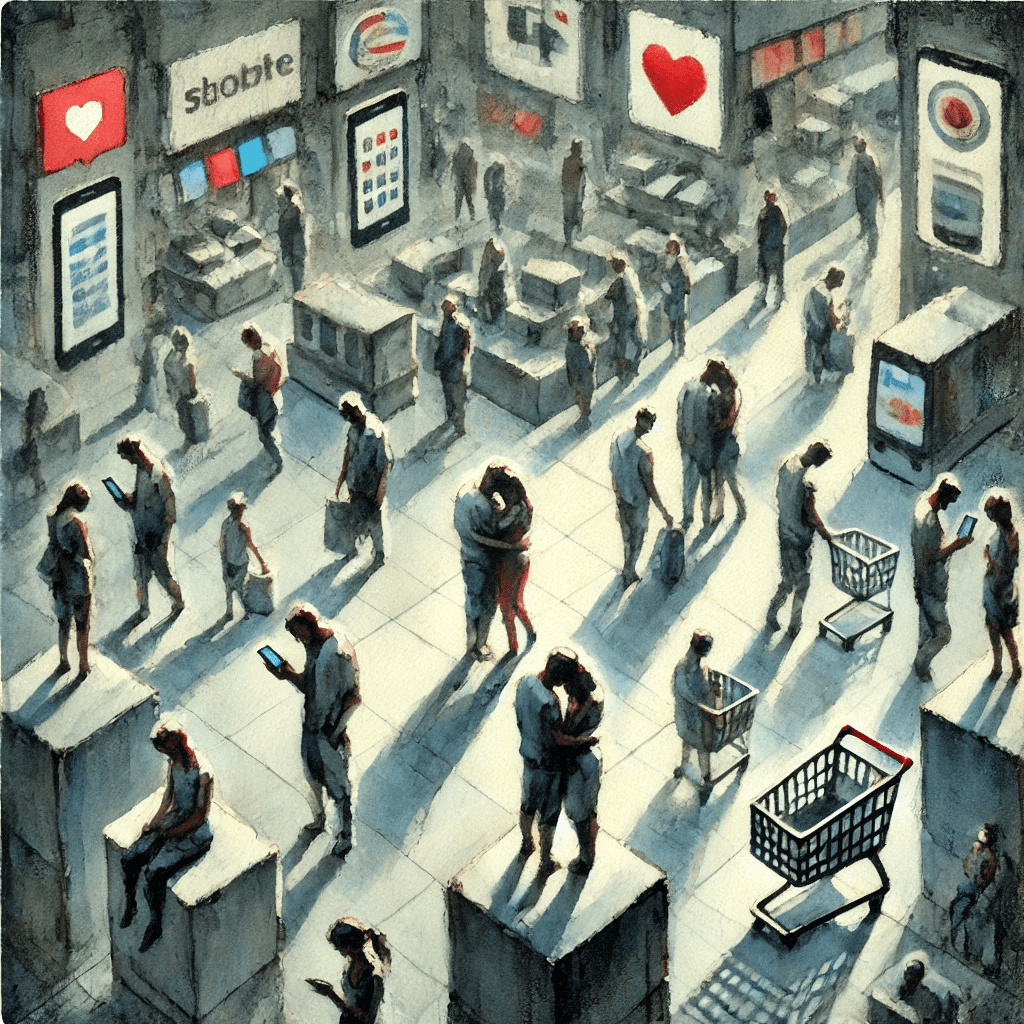
The magic of mass production has drastically changed our lives. We barely realize how much it has shaped our expectations and psyche. It is the reason we are increasingly unable to maintain long-term, romantic relationships. That may sound far-fetched, but stay with me.
Mass production has transformed the world. Since the 1990s, with China’s accession to the World Trade Organization, an enormous range of goods and services has become available to almost everyone. Of course, there are exceptions—a yacht remains reserved for a select few. But compared to the past, when artisanal production made goods scarce and expensive, we now live in an era where even the least fortunate own things that past kings could only dream of.
Alongside this material abundance, the landscape of human connection has also been reshaped. The rise of dating apps and social media has turned the quest for love into a marketplace of options, where potential partners are evaluated with the same disposable mindset applied to consumer goods. Research on the “paradox of choice” reveals that an overabundance of options often leads to decision paralysis and diminished satisfaction—a dynamic that mirrors our relentless search for the perfect partner.
Our brains have been conditioned by a world where almost everything is attainable. Smartphones illustrate this perfectly: while there are differences in price and brand, the functional gap between a cheap and an expensive model is often minimal. That principle inevitably seeps into our expectations regarding love and relationships. We want the best—the most beautiful, the smartest, the most desirable partner. And if we fail to find them? Then we’d rather have nothing at all. Modern consumer culture has convinced us that we are entitled to the best—”because we’re worth it,” as L’Oréal’s slogan proclaims. But in a world where everyone is searching for the top 5% of potential partners, it quickly becomes clear that this is mathematically impossible.
Historically, romantic relationships were guided by practical constraints and social conventions. Marriages were often less about idealized love and more about mutual responsibilities, economic security, and cultural compatibility. Compromise was not seen as settling but as a natural, necessary component of partnership. Today, however, the luxury of endless choice has distorted our vision of love, replacing pragmatism with a relentless pursuit of perfection.
This consumer mentality has also seeped into how we view ourselves. In an era where self-worth is increasingly tied to material possessions and curated online personas, the criteria for a partner are elevated by the very images of perfection peddled by consumer brands. The result is a nagging feeling of compromise whenever we accept a partner who does not meet an ever-escalating list of demands—even when that person is perfectly compatible on many levels.
Ironically, this mindset often causes relationships to fail. Not because the partner is inherently lacking, but because there is always a lingering sense that one has “settled” for less than the ideal. We want everything—and then some.
How do we break this cycle? I don’t have a ready-made solution, but it starts with awareness. We need to recognize how deeply the consumer mentality has infiltrated our thinking. Personally, I try to counteract this by radically simplifying my criteria for a partner. Instead of maintaining an endless list of demands, I have defined only three absolute must-haves—the rest doesn’t matter.
Ultimately, reconciling our romantic lives with the realities of modern consumer culture may require a broader cultural shift. Embracing imperfection and redefining success in relationships—not as a checklist of attributes but as a genuine connection—could transform the way we love. Perhaps instead of being insatiable caterpillars chasing an ever-elusive ideal, we might learn to be butterflies, content with what is real and enough.

 Khadim Zaman's Blog
Wonderful ♥️
LikeLike
Thank you 😊 🙏
LikeLike