On the 28th of February 2026, the United States and Israel launched a coordinated assault on Iran — one of the most extensive opening strikes in modern military history. Nearly nine hundred strikes in twelve hours. The Supreme Leader killed within the first day. Iran’s air defenses, much of its navy, its nuclear facilities, its command-and-control infrastructure: all targeted simultaneously. Trump told reporters that “just about everything’s been knocked out.” The operation, codenamed Epic Fury, was premised on a familiar logic: Iran was weakened, its proxies diminished, its people restless. The regime, the strategists calculated, would not survive a direct confrontation.
They were wrong.
By the thirty-fourth day of the war, Iran had launched its eighty-seventh wave of regional attacks. Israeli cities were being struck daily. US bases across the Gulf — Bahrain, Kuwait, Qatar, Jordan — had been hit repeatedly, some partially evacuated, their personnel sleeping in hotels. The Strait of Hormuz, the narrow corridor through which more than twenty percent of the world’s oil supply passes every day, was closed. Oil had spiked past a hundred and ten dollars a barrel. The International Energy Agency had released emergency reserves. The global economy was reeling. And Trump — who had promised victory in days — was now talking about an exit “in two to three weeks,” while his Defense Secretary described the strategy as “negotiating with bombs,” a phrase that contained, if one listened carefully, the sound of an administration searching for a door.
This is where the conventional analysis ends. Iran has suffered terribly. Thousands of civilians dead. Cities bombed. Leadership decapitated. The narrative being prepared in Western capitals was one of a wounded, humiliated Iran — punished into submission or, failing that, into irrelevance.
The contrarian argument begins exactly here.
The Tollbooth Idea
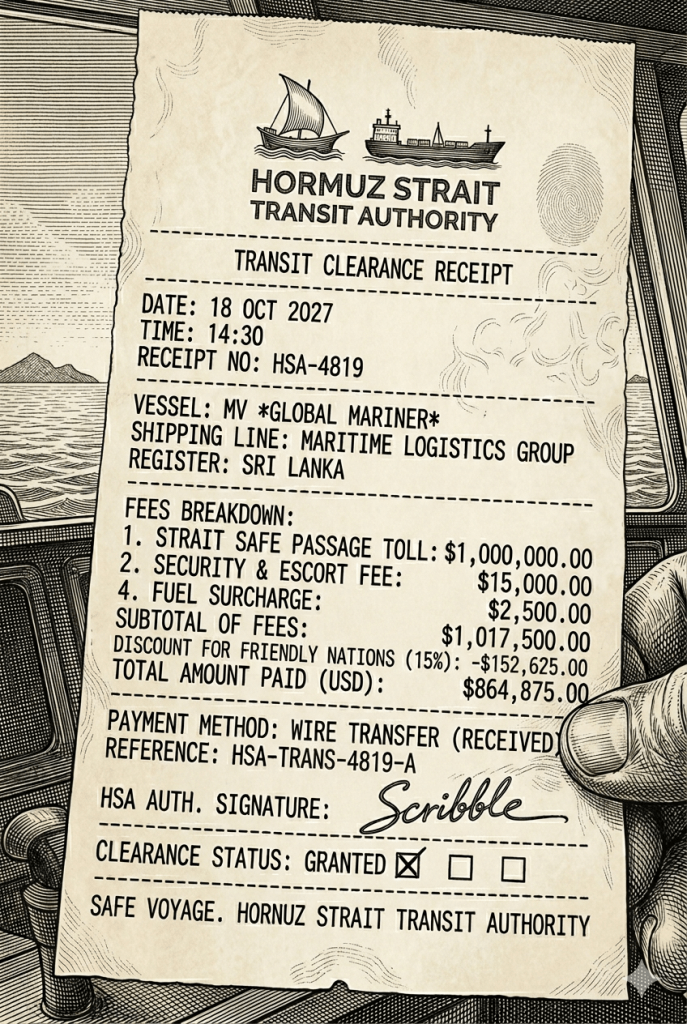
The idea is simple enough to state in a single sentence, and complex enough to spend an essay unpacking: Iran’s ability to close the Strait of Hormuz transforms it from a regional power into a structural superpower — one that controls the pressure valve of the global economy at a fraction of the cost of the American military machine that spent decades trying to prevent exactly this outcome.
The strait itself is the geography of leverage. It is twenty-one miles wide at its narrowest point. Through it passes the oil exports of Saudi Arabia, the UAE, Kuwait, Iraq, and Iran itself. Closing it does not require a navy that can match the United States. It requires mines, coastal missiles, and the willingness to absorb punishment. Iran has demonstrated all three. The asymmetry is not incidental — it is the entire point. The United States deployed aircraft carriers, B-2 stealth bombers, B-1 Lancers, B-52 Stratofortresses, and thousands of cruise missiles. Iran deployed mines, drones, and ballistic missiles produced domestically, under sanctions, at a fraction of the cost. And the strait remained closed.
“The tollbooth does not need to be formalized. It needs only to be credible. Iran has now made it credible in the most unambiguous way imaginable: under fire, from two nuclear-armed states, it held the gate.”
The first objection to this thesis is the one most immediately obvious: Iran is being destroyed. How can a country absorbing this level of bombardment be described as gaining strategic leverage? The answer lies in what “winning” means in a war of attrition. Iran does not need to defeat the United States militarily. It needs only to make the cost of continuing the war exceed the cost of accepting Iranian control of the strait. That calculation, as of this writing, appears to be reaching its tipping point. The Atlantic Council — not a publication friendly to Iranian interests — put it plainly in March 2026: Iran is calculating that it is more willing to absorb pain than either the United States or the Gulf states, and that if it retains the ability to inflict pain and keep energy prices high, it is more likely to determine the end of the conflict than Washington is.
The Dollar, the Desert, and the Forever War
To understand why the tollbooth thesis is not merely a military argument but an economic and structural one, it is necessary to step back from the immediate conflict and ask a question that Western media rarely poses with sufficient directness: why has the United States waged war in the Middle East, cyclically, for the better part of half a century?
The answer most commonly given — democracy, human rights, nonproliferation — fails on contact with the facts. The United States has supported some of the most repressive governments on earth when they served its interests, and destroyed relatively functional states when they did not. The more honest answer is oil — not in the crude sense of stealing it, but in the structural sense of controlling who controls it, and under what terms it flows to the global market.
This requires one more layer of explanation: why does the United States care so much about controlling oil if it is itself a major producer? The answer is the dollar. Since the collapse of Bretton Woods and the subsequent petrodollar arrangement — under which oil is priced and traded globally in US dollars — America’s ability to print money without triggering domestic inflation depends on global demand for dollars. That demand is sustained, in part, by the fact that anyone who wants to buy oil must first acquire dollars. An America that loses control of Middle Eastern oil supply loses, gradually but inexorably, the financial mechanism that makes its global military presence affordable.
The Forever Wars, seen through this lens, are not aberrations or failures of judgment. They are the operating cost of dollar hegemony. And that cost is paid not only by American taxpayers, but by the entire world, which absorbs the inflation exported through dollar-denominated trade — and which, in the most literal sense, funds the bombs dropped on its behalf whether it consented or not.
“There is a bitter irony in this mechanism that deserves to be stated plainly: the populations of developing nations, who hold dollar reserves and trade in dollar-denominated commodities, have spent decades effectively subsidizing the military campaigns that destabilized their neighbors, drove up refugee flows, and kept oil prices on a permanent knife-edge of geopolitical risk. They paid for the wars with their currency. They received the instability in return.”
Now consider what the tollbooth changes. If Iran becomes the effective gatekeeper of Hormuz — not through formal declaration, but through demonstrated capability and the credible threat of closure — then the cost of disrupting Middle Eastern oil supply shifts from “US military expedition” to “negotiate with Tehran.” An Iranian toll on Hormuz, even a steep one, is almost certainly cheaper for the global economy than the system it would replace. A toll is predictable. It can be budgeted. It does not produce refugee crises, destroyed infrastructure, or oil price spikes driven by the chaos of active warfare. The Forever War model, by contrast, costs the world trillions while delivering the illusion of stability punctuated by periodic catastrophe.
The Objections, Taken Seriously
An argument is only as good as the objections it can survive. Several were raised in the course of developing this thesis, and intellectual honesty requires engaging them rather than papering over them.
The first: Iran is not a rational gatekeeper. The IRGC is a political actor, not an economic one. A tollbooth administered by the Revolutionary Guard would likely function as an instrument of Iranian foreign policy — favorable terms for China and Russia, weaponized pricing for adversaries — which merely replaces American hegemony with Iranian hegemony, a different problem rather than a solution.
This objection has force. But it overestimates the difference between the two systems. American hegemony over Middle Eastern oil has never been neutral or market-driven. It has always been an instrument of US foreign policy, with favorable terms for allies and punitive disruption for adversaries. The question is not whether the tollbooth would be perfectly fair — it would not be — but whether it would be more stable and less costly than the alternative. Given that the alternative has produced multiple land wars, the destruction of functioning states, and half a century of regional catastrophe, the bar is not high.
The second objection: Iran’s navy has been largely destroyed. How does a country without a credible surface fleet administer a maritime chokepoint? The answer is that administering Hormuz does not require a conventional navy. It requires exactly what Iran has demonstrated it possesses: coastal missile batteries, underwater mines, drone swarms, and the organizational capacity to deploy them under sustained bombardment. These are asymmetric tools, and they are cheaper to maintain and harder to permanently neutralize than any surface fleet. The United States destroyed Iran’s conventional naval assets while leaving intact the very capabilities that close the strait. That is not a strategic victory — it is a demonstration of the limits of conventional military supremacy.
The third objection — and the most interesting — is about internal Iranian coherence. A wounded state, leadership decapitated, new Supreme Leader untested, wartime trauma still fresh: does such an Iran have the institutional stability to function as the rational long-term actor that the tollbooth model requires?
Here the proper reweighting of these objections becomes important. The second-order uncertainties — Mojtaba Khamenei’s legitimacy, the internal power balance between IRGC factions, the pace of post-war reconstruction — are real but administrative in nature. They are the kinds of problems that get resolved through time, negotiation, and the basic arithmetic of self-interest. They are not structural impediments to the model. The first-order fact — that Iran has demonstrated the ability to close the world’s most critical oil chokepoint while being simultaneously bombed by two of the world’s most advanced militaries — is not reversible. No future American administration can un-know that Iran can do this. No future strategic calculation can ignore it. The proof of concept has been made at the highest possible cost, and it held.
The Gift of Direct War
There is a dimension of this conflict that most Western analysis misses entirely, because it requires taking Iranian domestic politics seriously on its own terms rather than as a backdrop to American decision-making.
The Iranian regime’s internal legitimacy problem, before February 28th 2026, was fundamentally economic. Forty years of sanctions had produced genuine hardship. The gap between the regime’s revolutionary rhetoric and its ability to deliver prosperity was widening. The protests of early 2026 — which the West interpreted as a sign of the regime’s imminent collapse, and which partly encouraged the decision to attack — were, at their root, expressions of economic exhaustion.
The direct US-Israeli assault did not exploit that vulnerability. It healed it.
The regime had spent four decades invoking the American and Israeli threat as the reason for sacrifice. The population had grown tired of the invocation. Then the bombs started falling on Tehran. The enemy that had always been named as the source of Iranian suffering revealed itself — not as propaganda, but in reality, from the sky. The gap between ideology and experience collapsed overnight. Whatever fractures existed within Iranian society did not disappear, but they were subordinated to something more immediate: the fact of being under attack.
This is not an accident of history. It is, in a bitter and ironic sense, a strategic gift — not one Iran asked for, but one it has been preparing to receive for four decades. Iran has been building asymmetric military capability, domestic industrial self-sufficiency, and ideological frameworks for exactly this scenario since 1980. The war with Iraq in the 1980s, the proxy conflicts across the region, the endurance of sanctions that would have broken most economies — all of it was preparation for the moment when the confrontation became direct. When the moment arrived, Iran was ready in a way that its attackers, fixated on its visible weaknesses, had failed to account for.
The Sanction Trap Reversal
The economic argument for the post-war trajectory of Iran is, in some ways, the most striking element of this thesis — because it suggests that the very mechanism used to weaken Iran for forty years has inadvertently built the foundation for its emergence as an economic powerhouse.
Consider what forty years of sanctions actually produced. Unable to import freely, Iran was forced to develop domestic manufacturing, engineering, and industrial capacity across sectors that oil-rich states typically neglect. It built a large, educated middle class in the absence of easy petrodollar distribution. It developed pharmaceutical, automotive, aerospace, and defense industries that function — imperfectly, but genuinely — under conditions that would have collapsed less determined economies. The sanctions did not modernize Iran in the way the West intended by imposing them. They modernized Iran in the way necessity always does: by removing the option of dependence.
Now imagine those constraints lifted. Not hypothetically, but as the predictable consequence of a post-war settlement in which the world economy — specifically, the portion of it that needs Hormuz open — compels the United States to accept Iranian terms. The Iranian economy, which has been operating at a fraction of its potential capacity for four decades, would not merely grow. It would decompress. The analogy to China’s post-1978 growth is instructive but may actually understate the case: China grew from a low base with limited prior development. Iran would be releasing potential energy that has been accumulating under pressure for forty years, in an economy that has demonstrated, under the worst conditions imaginable, that it can build sophisticated industries and sustain complex social organization. The growth curve, when it comes, may be unlike anything the modern world has seen.
“The sanctions did not prevent Iranian power. They compressed it. The war may be the event that releases it.”
The internal struggles that were the regime’s greatest vulnerability — the economic frustrations of ordinary Iranians — would not survive this transition. They are not ideological disagreements. They are hunger, unemployment, currency depreciation, and the inability to access global markets. All of these are soluble problems once the sanctions regime collapses. And the sanctions regime will collapse, not because the United States develops a sudden appreciation for Iranian sovereignty, but because the global economy will demand it. Every month that Hormuz remains effectively threatened is a month of higher energy prices, supply chain disruption, and political pressure on every government in the world. The US will lift the sanctions begrudgingly, under structural compulsion. But lift them it will.
The Fatwa and the Bomb That Was Never Built
There is one final dimension of this argument that is, on reflection, the most elegant and the most overlooked: the relationship between Hormuz as a strategic weapon and Iran’s longstanding position on nuclear weapons.
For decades, the Iranian regime — specifically its supreme religious leadership — issued a fatwa declaring the development, stockpiling, and use of nuclear weapons to be forbidden under Islamic law. The reasoning is not complicated: nuclear weapons are weapons of indiscriminate mass destruction. They cannot be used without killing civilians on a massive scale. And in fourteen centuries of Islamic jurisprudence, the deliberate targeting of civilians is categorically prohibited. The fatwa was not a diplomatic gesture. It was a legal ruling from scholars who take their legal tradition seriously.
The West, almost universally, dismissed this as propaganda. Of course Iran wants the bomb, the analysis went. The fatwa is cover. The evidence of enrichment, the expansion of centrifuge capacity, the refusal of certain inspections — all of it was read as proof that Iran was lying about its intentions. The IAEA, just days before the February 2026 attack, stated that it found no evidence of a structured nuclear weapons program. This finding was set aside. The bombs fell anyway.
Now consider what Hormuz changes about this picture. The nuclear weapon, rationally understood, was always a last resort — an existential deterrent for a state that could not match its adversaries through conventional means. The fatwa permitted the development of such a weapon only in the case of existential threat to the Islamic Republic. Iran was not building the bomb because it wanted to. It was keeping open the option of building the bomb because it lacked an alternative deterrent.
Hormuz is that alternative. It is, in purely strategic terms, a superior deterrent in almost every relevant dimension. It does not require crossing moral or religious lines. It does not invite nuclear retaliation. It does not kill civilians. It is not vulnerable to missile defense systems. And — critically — it has already been deployed and has already worked. Iran now possesses a weapon that costs a fraction of a nuclear program to maintain, that can be used without triggering international condemnation or retaliatory nuclear strikes, and that causes immediate, measurable, global economic pain within days of activation.
This means Iran can now prove the fatwa was sincere. It can demonstrate to the world — and to its own population — that the nuclear option was never the goal. It was the insurance policy held in reserve by a state that lacked better options. The better option has now revealed itself, tested under fire, and validated. The insurance policy can be retired.
The strategic inversion this creates for the United States and Israel is devastating. For forty years, the organizing justification for sanctions, proxy conflicts, and direct military action has been: Iran is building toward a nuclear weapon, and the world must be protected from a nuclear-armed Iran. If Iran emerges from this war without a nuclear weapon, having demonstrated a more effective deterrent, the question that follows cannot be answered: what, exactly, were you preventing? The IAEA said there was no weapon. Iran said it didn’t want one. Oman said a deal was within reach. And then the bombs fell.
Hormuz as the revealed strategic weapon strips away the last diplomatic cover from the operation. It forces a reckoning with what the war was actually about — what it has always been about. Not nuclear proliferation. Not regional security. Imperial ambition, plainly stated: the desire to maintain American hegemony over the Middle East’s energy flows, and the Israeli vision of regional dominance uncontested by a capable Iranian state. These are not illegitimate interests, from the perspective of those who hold them. But they are not the interests that were announced. And the gap between the announced interest and the real one is the measure of the dishonesty on which the entire enterprise was built.
The New Architecture
What does the world look like if this argument is correct — if Iran survives the war of attrition, compels a US withdrawal, and emerges as the effective gatekeeper of Hormuz?
It does not look like utopia. It looks like a different set of problems, administered by different hands, under a different logic. Iranian control of Hormuz will be partial, contested, and governed by a regime that has its own imperial instincts and its own vision of regional order. The Gulf states will make their accommodations — not warmly, not quickly, but ultimately, because their alternative is permanent war with a state that has just proven it can withstand the most intense bombardment since the Second World War. China, which has been Iran’s primary economic partner through the sanctions decades, will need to navigate the transition to a post-sanctions Iran that can trade with the world — a transition that complicates Beijing’s privileged position but also opens enormous opportunities for Chinese investment in Iranian reconstruction.
None of these are trivial problems. But they are negotiable problems. They are the problems of a new regional order finding its equilibrium, which is a different category of problem from the one the world has been living with: the endless, expensive, destabilizing, and ultimately futile attempt to maintain American hegemony over a region that has, demonstrably, decided it is no longer willing to be administered from Washington.
The tollbooth is not a perfect instrument. But it is a comprehensible one. Its logic is visible. Its costs are quotable. Its terms can be negotiated. It responds to economic pressure in ways that military occupation never does. And it is operated by a civilization with a continuous history stretching back three thousand years — a civilization that, whatever its current government’s faults, has shown across decades and across this war a capacity for strategic patience, institutional resilience, and the honoring of agreements, that its adversaries in this conflict conspicuously have not.
The world has been paying for American hegemony over Middle Eastern oil since at least 1953. It has paid in dollars exported as inflation, in oil price shocks driven by manufactured instability, in the moral cost of weapons dropped on civilian populations in the name of freedom. If Iran’s Hormuz gambit succeeds — and the evidence, as of this writing, suggests it is succeeding — the world may be about to pay a toll instead. A toll, for once, with a fixed price. A toll that does not come with cluster munitions. A toll that, whatever its amount, is almost certainly cheaper than what came before.
* * *

 Khadim Zaman's Blog